
As we move through 2026, my reflections on the gaming landscape are still dominated by the seismic impact of Elden Ring. FromSoftware's monumental 2022 release didn't just win awards; it fundamentally rewired our expectations for what a Soulslike experience could be. By masterfully weaving together the defensive posture of Dark Souls, the aggressive tempo of Bloodborne, and the stealth-infused dance of Sekiro, the studio created a world that felt less like a game and more like a living, breathing ecosystem of challenge and discovery. It was a breath of fresh air in a genre that had begun to feel as predictable as a pre-scripted boss cutscene, and its shadow looms large over everything that has come since.
The Bittersweet Echo of Lordran
This new standard, however, has cast a long and complicated shadow over FromSoftware's own storied past. Returning to the hallowed halls of Dark Souls now feels like trying to read a beloved, ancient manuscript after experiencing a fully immersive holographic archive. The love is still there—the intricate level design of Undead Burg, the haunting beauty of Anor Londo—but the boundaries are suddenly, painfully visible. Where Elden Ring presented the Lands Between as a vast, contiguous tapestry, the original Souls games now feel more like a series of exquisitely crafted but ultimately isolated dioramas. You could gaze from the Undead Burg ramparts down into the misty depths of Darkroot Basin, but the journey between them was a curated, linear path, not an open invitation to chart your own course.
This contrast is perhaps most stark in Dark Souls 3's Irithyll of the Boreal Valley. The view from Pontiff Sulyvahn's arena is breathtaking, showcasing frozen wastes that stretch to the horizon, landscapes that plead for exploration. Yet, they remain forever out of reach, beautiful backdrops to a play confined to a narrower stage. The world of the classic Souls games was like a masterfully composed symphony heard from outside the concert hall—you catch the glorious melodies, but the full, enveloping experience is just beyond the walls.
The New Grammar of Combat and Exploration
Elden Ring's open world did more than just expand the map; it invented a new vocabulary for conflict. The freedom transformed encounters from structured tests into emergent, cinematic stories.
Iconic Open-World Encounters:
-
The Night's Cavalry: Patrolling the fog-shrouded roads, their appearance turning a routine ride into a desperate nighttime duel.
-
The Dragons: Engaging a colossal, flying beast from the back of your steed, Torrent, in a chaotic ballet of fire and steel across an open plain.
-
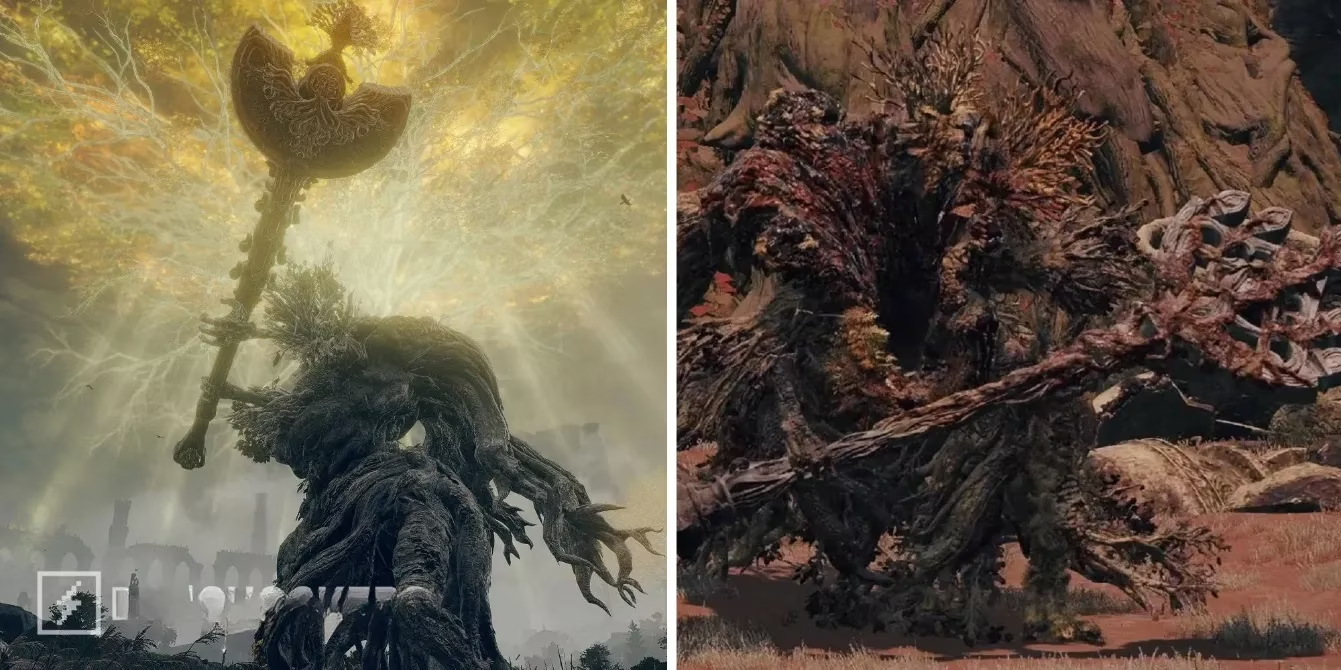
The Tree Sentinels: That first, brutal lesson in humility at the gates of Limgrave, teaching you that some fights are about hit-and-run tactics and patience, not just standing your ground.
These moments thrived on seamless transition. There was no loading screen or formal arena announcement; exploration fluidly bled into life-or-death struggle, with the option of a tactical retreat on Torrent adding a thrilling new layer of strategy. The world itself became an active participant in every fight.
The Unattainable Peak and the Path Forward
This creates a unique dilemma for the dedicated fan. The classic Souls games are foundational texts, their design philosophies as elegant and precise as a katana's edge. Yet, after roaming the Lands Between, their once-sprawling realms can feel curiously claustrophobic. Elden Ring set a new benchmark that, like a gravity-defying Sites of Grace, pulls all discussion toward it.
| Aspect | Classic Souls Design | Elden Ring's Evolution |
|---|---|---|
| World Structure | Interconnected, curated levels | Seamless, vast open world with legacy dungeons |
| Exploration Flow | Guided, path-based discovery | Organic, player-directed adventure |
| Encounter Design | Largely structured, arena-focused | Dynamic, often emerging from the landscape |
| Travel & Scale | Foot-based, intimate scale | Mount-based, epic geographical scope |
Looking ahead from 2026, the question for FromSoftware is not whether to abandon their roots, but how to evolve. While some purists may always prefer the tightly coiled tension of a traditional Souls corridor, Elden Ring proved that grandeur and freedom could coexist with the studio's signature punishing mastery. The future of the genre now lies in reconciling these two strengths. The hope is that FromSoftware continues down this hybrid path, crafting worlds that are both boundless in scope and dense with the meticulous, nerve-wracking detail that first captured our hearts. After all, once you've fought a dragon in an open sky, returning to a predefined arena can feel like trading a symphony for a solo—still beautiful, but missing the overwhelming scale of the orchestra.